
Break-up Grief
What grief has been teaching me after a sudden breakup - and why it feels like work.

If you were to have a bad cut on your arm, you’d feel pain. And you would know to trust the pain as something important, sending a vital message: pay attention, take care, rest, tend and heal. The pain of grief asks just the same as the pain from a physical wound. Freud called the process of grief Trauerarbeit, meaning grief work. Work, labour, graft.
I have this work to do. No one has died, but I’m experiencing a real loss - a three-and-a-half-year relationship ended suddenly at the end of the year.
I don’t intend this to be autobiographical, rather to reflect on what it’s like to live inside grief with psychological awareness. I almost always find the inner workings of my own mind interesting - like a fascinating puzzle - and the learning potential helps me, even in the most awful pain. Suffering without learning is just suffering. I aim to take the messages that are given and so don’t feel that the suffering is going to waste. If anyone reading this finds it useful too - all the better. But I know I am writing this to help me figure it all out - to do the grief work.
This might be the most personal blog post yet, and I am minded of Lori Gottlieb’s words (from her wonderful book Maybe You Should Talk to Someone):
Therapists, of course, deal with the daily challenges of living just like everyone else. This familiarity, in fact, is at the root of the connection we forge with strangers who trust us with their most delicate stories and secrets… we know how hard it is to be a person. Which is to say, we still come to work each day as ourselves with our own sets of vulnerabilities, our own longings and insecurities, and our own histories. Of all my credentials as a therapist, my most significant is that I’m a card-carrying member of the human race.
Carl Rogers, the originator of person-centred therapy, conceived of the idea of a ‘fully functioning person’ as someone who does not avoid feeling pain, who does not defend themselves from it, nor distort it. Even with many years of psychological training, I am reminded that knowledge does not exempt me from pain. Knowledge has helped me with permission: to feel without panicking, to trust the process rather than control outcomes. Knowledge has given me the courage to stay with my current grief.
I know that Freud’s grief work describes an active and emotionally demanding internal process, where the mourner must consciously bring memories and expectations of the lost object into contact with the reality that the object is gone. Believe me - I do not want this grief! Yet rather than attempting (futilely) to rigidly control life, I’m intending to respond to it as a real, immediate experience, rather than something that “shouldn’t” be happening.
Behind my person-centred theoretical guide there is always the pulse of Eastern philosophy that beats in harmony. I’ve been listening to Alan Watts of late - I strongly recommend his recorded lecture series called Out of Your Mind - even if just to absorb his beautiful oratory style. Watts was a British philosopher known for interpreting Eastern philosophies for Western audiences, especially on how to live in harmony with the flow of life.
Like Rogers, he believed that heeding inner experiences enables integration and growth. Life is like a river, says Watts, and if we attempt to go against the current, we exhaust ourselves. He describes flowing with the river as a releasing of control - not in a passive way, but in a way that intelligently engages in the unfolding of life.
“The only way to make sense out of change is to plunge into it, move with it, and join the dance.”
“We are all floating in a tremendous river… the art of the thing is to swim with it.”
Well, I’ve been swimming in this river, and I’m going to try and describe what it’s been like.
My relationship mattered and had deep emotional meaning for me. I now must mentally catch up with the fact that it’s gone. After that length of time, I cannot flick a switch to stop my brain from reaching out. I still seek the co-regulation I once had in the relationship. The attachment is ruptured, but my nervous system does not yet fully compute. And there’s no fast-forwarding psychological integration - no shortcut. Time is the key to bridging the gap between what has gone and what is now. My psyche needs to reorganise meaning, which is a process.
What I’m experiencing are days of acute, deep pain - felt physically and psychologically. It’s an ache, an anguish, with visions that invoke longing for reconnection. I feel it viscerally: it’s harder to eat, my chest feels tight, and I often feel that vulnerability behind the eyes where tears are ready to spill. I write this knowing that what I describe will be recognisable to most - if not all - of you.
And then I have days when I feel okay. Quite good, in fact! I find relief in not needing to attend to all the small compromises made whilst in a relationship. I can feel deep gratitude and joy in my own life - my family, friends, my work, my own rhythms and resources. I can have times when I look forward to new adventures.
This oscillation makes sense - it is how the brain digests the rupture, the loss, the present and the future. The Dual Process Model of grief, developed by Margaret Stroebe and Henk Schut in the 1990s, builds on Freud’s idea that confronting the pain - remembering, yearning, weeping - is the central task of grief. They also emphasise the need to reinvest in our future, adjust to a new present, take a break from grief - sometimes that means chilling out and watching Netflix. This swinging between the two states helps the brain find balance, like Newton’s Cradle: energy swings back and forth until the system stabilises.

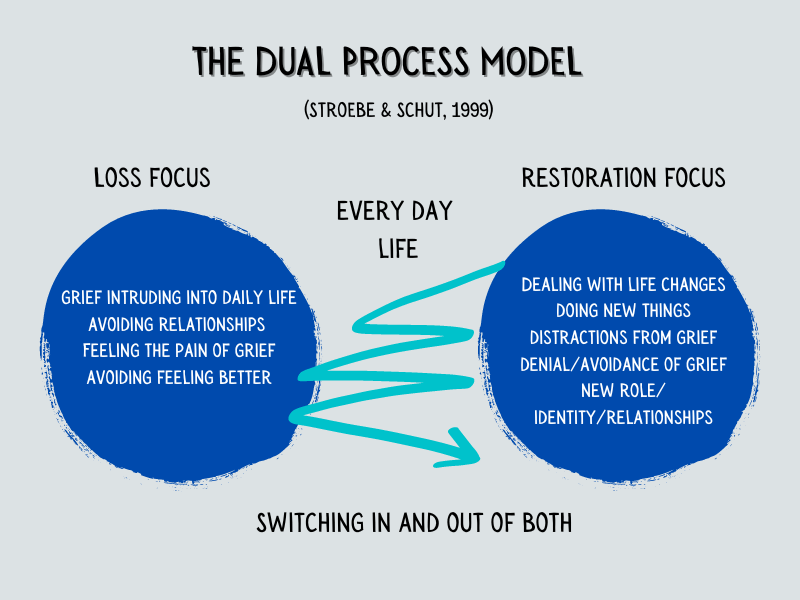
Just like that cut on your arm - if you were to constantly clean it with antiseptic and worry at the wound, it would not heal. Neither would it if you wrapped it in a bandage and ignored it. The wound needs to be cleaned as well as left alone.
I’ve been struck by the quiet wisdom of my body and psyche. I don’t mean this to sound as though I think I’m particularly wise; rather, I’ve become aware of an inner voice that often seems to know better than my conscious mind. I believe this voice exists in all of us.
Different traditions name this inner guidance in different ways. Rogers might call it the organismic valuing process, or the self-actualising tendency - an inherent orientation toward growth. Alan Watts might speak of the Buddha Mind: a wise, spacious awareness beneath our usual thinking. Jung might locate it within the Collective Unconscious, while Roberto Assagioli describes it as the Witness or Observing Self. Though the language differs, each points toward the same idea: a self-regulating principle operating beneath conscious awareness.
I’ve experienced this most vividly through a series of dreams that have felt genuinely guiding. What astonishes me is not just that my psyche seems to participate in this process, but that it can show me something I wasn’t consciously ready to know. This kind of tacit knowing - wiser than my longings, yet unmistakably my own - is deeply paradoxical and resists my full understanding.
Anyway:
The first dream: I was asked by my ex-partner to face my fears. So, I jumped off a cliff! Whilst falling, I realised that it really wasn’t so bad - I discovered I had wings. I don’t think you need to be Jung or Freud to interpret that dream.
The second dream: I desperately wanted to see him, so I got on a bike and cycled downhill to his house. When I got there, I lost my bike. I had been really worried about getting back, as it was going to be uphill all the way. My daughter came and rescued me. When I woke up the next morning, it occurred to me that the bike was my autonomy. As for the downhill getting there and the uphill getting back - no interpretation needed! Ditto my lovely daughter rescuing me.
The third dream: I dreamt that a friend and I went back to a beloved Airbnb to enjoy it again. Whilst entering, she explained that she hadn’t booked it. I protested; she insisted that all was fine. We sat down and watched telly, eating snacks. I was appalled at violating a space that did not belong to me - we were trespassing, and I knew it. When I woke up, I was quite sure that the Airbnb symbolised my relationship. It is no longer a place of belonging, and going back would only feel appalling.
A few years ago, my daughter, after a break-up of her own, said to me:
“Mum - is this what grief feels like? It feels as though I have a problem that can’t be solved.”
Yes - a problem that can’t be solved. I think even the cleanest grief must feel like that. Something you have lost that cannot be retrieved. So hard. And yet - maybe it is solvable. It occurs to me that the work of grief is to reach the safety of truth.
I use the term clean grief. Grief can get complicated in breakups where there is a clash of desires, wants, and needs. Choices and decisions can be hurtful. For me, this thickens the grief, nesting extra losses within the primary loss. I have lost a future that had begun to feel inhabited. I also risk losing my narrative of the past. I am asking myself: Was this ever real?
In my search for truth I have longed to have that open, honest conversation with my ex-partner, to experience the co-regulation we used to have, and to feel it was real through being with him again. I also know he’s no longer the person who can offer me what I need. My dream has told me that seeking that attachment again would feel wounding - just like trespassing. I also think that for both of us, wounds create an emotional collision between injury and empathy. We may both need to defend ourselves, making true openness and vulnerability impossible.
I have found safety in the empathy, acceptance, and realness of my friends and family, offering heartfelt comfort on my journey to the safe harbour of truth.
I have been aware of the temptation to vilify, to rewrite my experience so that he becomes unworthy of love - and therefore easier to reject. But that doesn’t wash with me. I want a real version of what happened over the last three-and-a-half years. The love was real. The ending was real. They coexist. One does not cancel the other. The difficulty is learning how to hold both without letting the ending rewrite the love.
I have asked myself what I remember of the relationship. I wrote down a list of memories and found that the only real primary source I have - my direct experience - has been my best teacher. I have learnt that the relationship felt joyous at times, connected, offered good company and many laughs. There were difficult times when the cracks showed. At those times, it was information, not predictions - so I shan’t beat myself up for not knowing how it was going to end.
Perhaps one of the most painful truths that grief has asked me to acknowledge is that love is something I had, not something that is owed.
Grief can leave you feeling hollowed out, as though love has been taken, and the space is empty and cold. And yet, from a person-centred perspective, when any experience is symbolised and accepted, the organism moves towards greater openness, not less. It increases congruence - being true to oneself - which is the foundation for deep connection and increases capacity for relationship.
So maybe it is as though I’m scooping out a space, hollowed, yes, but making capacity for what comes next - for love, for emotional depth. I hope so.
I’d love to hear from you. If you’ve experienced loss, a breakup, or the end of an important relationship, feel free to share what helped you navigate it, how you made sense of grief, or any insights you’ve gained along the way. Is there anything in this piece that resonates with you? Or is there anything that you see differently?
References
Gottlieb, L. (2019). Maybe you should talk to someone. Boston, MA: Houghton Mifflin Harcourt.
Rogers, C. R. (1961). On becoming a person: A therapist’s view of psychotherapy. Boston, MA: Houghton Mifflin.
Stroebe, M., & Schut, H. (1999). The dual process model of coping with bereavement: Rationale and description. Death Studies, 23(3), 197–224.
https://doi.org/10.1080/074811899201046
Watts, A. (2017). Out of your mind [Audio lectures]. Boulder, CO: Sounds True.
Hello Juliana, this is beautifully and tenderly written. I am going through the grief and loss of a relationship that I thought would rise above our differences. The yearning to see them and feel their presence has, at times, been overwhelming. I refuse to give in to the urge to reach out, knowing full well that is not my space anymore. The sense of rejection and injustice I'm feeling is natural, and I'm okay sitting with these emotions. There is no switch to stop thoughts of her. I hold space in my heart for her, but over time she won't take up all the space; it will make room for an expansion of love—one that is more aligned with my needs and offers safety
Hello Juliana, thank you so much for sharing so openly and with such integrity, these feelings and experiences you are moving through. I am reminded of a relationship that ended very abruptly and unexpectedly for me some years back. It was such a shocking experience for my mind, body and heart to receive. I felt physically like I was burning. I also recall some feelings of panic during 'the conversation'. (The fact that I am using the word 'recall' is indicative that those feelings are in the past and I am now using memory to reflect on experiencing them). My way to cope and process what I was experiencing at the time was to fully accept the changing circumstances and to focus on sending love to the other person in the choices they were making for their life. I also focused on sending love to others who were involved in the situation (who were deeply influential in the decision of my ex-lover to leave). I found that by focusing on sending them all love and trying to recognise that they were all on their paths through life as I was on mine, really really helped my own processing. I am aware that as I write this, it may seem almost 'noble' that I am saying this was my process and that it was such an easy and natural thing for me to accept and embrace the situation and those involved. It was not. I was utterly heartbroken. But this, I felt, had to be my focus. I had to see my life and existence as a cog in the huge wheel of existence through time gone, the present, and into the infinite future. A surreal experience began to unfold as I was sending this love every day, every hour (every minute when I was feeling truly in the waves of deep sorrow) - I began to feel such love, universal love, literally pouring into me, channelling through me - not only replenishing and recharging me but coming in abundance and filling me. If I had read this as a 'tip' for dealing with the grief of a relationship break-up, I think I would have through "well, I'll give it a go, it sounds like a good theory". However, I hadn't, I just felt compelled to do this, it felt like it just came to me to do it and that I had to fully commit to it, for everyone involved's sake. I felt I was directed to process in this way and it was mind-blowingly effective. I am grateful to you for both sharing these tender times you are experiencing and for prompting me to reflect on a time in my life (and what I can bring from that into my present too). A gentle hug coming your way if/when you want it too.